

What customer retention means and why it shows up directly in sales
Customer retention is your business's ability to get people to come back. Marketing brings the customer in the first time. Loyalty brings them in the fifth time, and the difference between the two reads straight off the month's takings.
Retention lifts sales in three ways. The first is frequency: a customer who comes in three times a week generates more revenue than one who comes once a month, even if both order exactly the same thing. The second is the value of the bill, because a loyal customer more easily orders extras, the pastry next to the coffee or the dessert after the meal. The third is recommendations, which bring you new customers with no extra promotion cost.
A reference often cited in the industry comes from Bain & Company: a 5% increase in retention can lift profit by 25% to 95%. The range is that wide because it depends on margin and on the trade, so treat it as a general guide rather than a promise.
Whatever the trade, one thing holds. A customer who comes back usually costs you less than a new one: you no longer pay to promote your way back to them, and they no longer need convincing from scratch about the coffee you make or the kitchen you run.
What a returning customer is worth
The figures below are indicative. Put your own in and you will see the result for your business straight away.
Take two customers with the same average bill, 5 EUR. One comes once a month, so 12 visits a year and 60 EUR. The other comes three times a week, around 150 visits a year and 750 EUR. The second is worth twelve of the first, without ordering anything extra.
In a restaurant the sum looks different, with larger bills and rarer visits, and in a shop it is the other way round. The ratio shifts from one case to the next; the conclusion does not.
You do not need to turn every customer who walks in into a regular. If ten out of a hundred monthly customers start coming twice, you have added 600 EUR a year without a single new customer.
The second element of the calculation is what the reward costs you. A coffee on the house costs you what you paid for the ingredients, not what you would have taken for it. For a coffee sold at 3.50 EUR, the direct cost usually lands between 0.80 and 1.20 EUR, depending on beans, quantity, milk and packaging. That is why the sixth coffee free pays for itself out of the margin on the other five.
The conclusion is simple: loyalty is paid for out of margin, as long as you pick the reward well. Next we look at how to choose the right reward.
How to make customers come back to a coffee shop
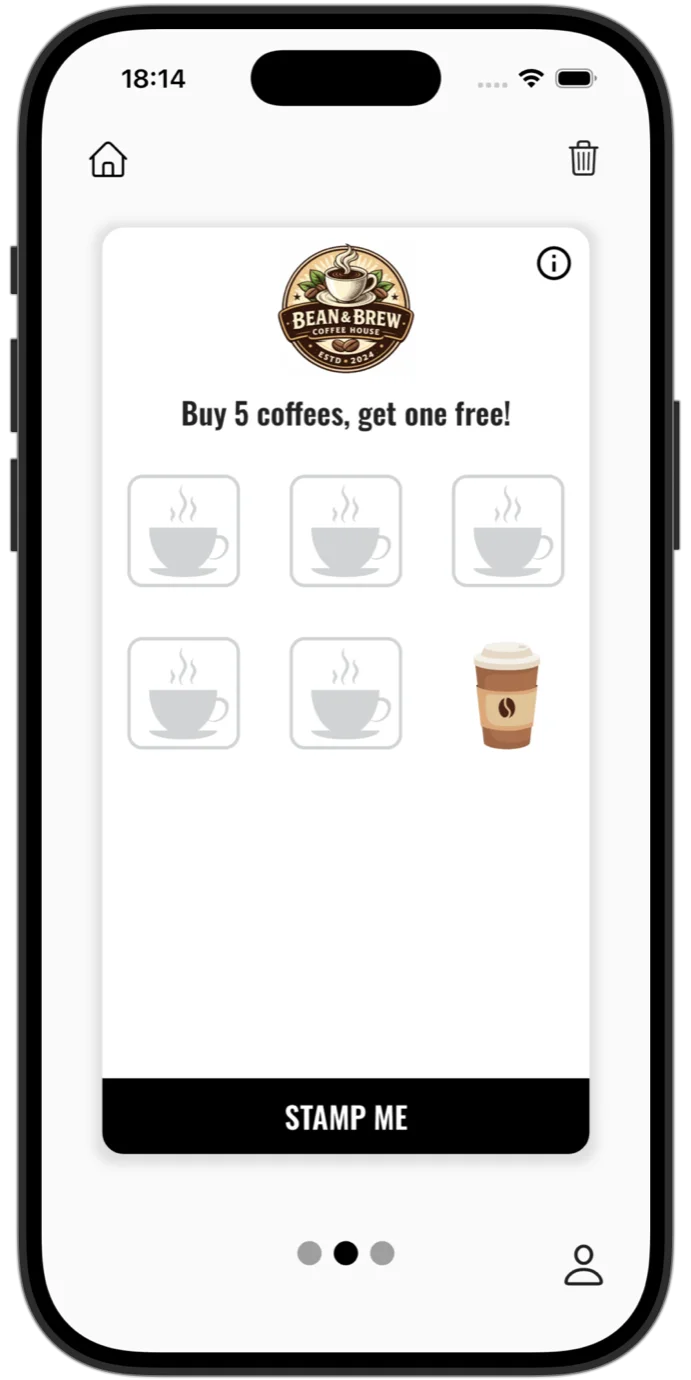
In a coffee shop people come often and order much the same thing, so stamps are usually the right choice. At 5+1, the sixth coffee is on the house, and staff can explain it in a single sentence.
The number of purchases needed for the reward is chosen by how often the regular customer comes in, not by how much you are willing to offer. The useful benchmark: they should reach the reward in about four weeks, which for many coffee shops means 5+1. If the reward is easy to reach, the customer stays motivated. If it is too far away, the customer forgets the program.
If the bills vary a lot, because you also sell brunch, cakes or beans by the bag, a points-based system (cashback) is a better fit. With stamps, an espresso and an 18 EUR order get exactly the same thing. In a points system, the customer accumulates in proportion to the value of the purchase, so they have one more reason to take the cake as well.
How you choose between the two and what reward to set are covered on the page about the loyalty program for coffee shops. At Cafizzio, Nish Coffee, Mabo Coffee and Tamper Coffee the card is already in their customers' phones.
How to make customers come back to a restaurant
In a restaurant the bills differ a lot and people come in more rarely. A stamp rewards a table of two and a table of eight the same, so a points-based system is a better fit here: the customer accumulates in proportion to the value of the order.
A simple setup is: 1 point for every 10 EUR spent, and one point is worth 1 EUR. It is exactly what My Thai uses. It applies to the whole bill, so the customer does not have to remember what earns points and what does not.
Two aspects matter:
- Choose a reward based on a dish you make yourself, a dessert or a soup, at the customer's choice. The real cost comes from the ingredients, not the menu price. And if the points can also be spent on bottled drinks, where the margin is thin, choose the 5% option.
- Set a minimum value before the reward can be used, otherwise customers only use a few euros of their points at each visit and the reward loses its perceived value.
How it all looks in practice is on the page about the loyalty card for restaurants.
How to make customers come back to a shop
In a shop the margin is thinner and part of the shelf is goods bought for resale. It is not the value of the reward that matters most, but the product you offer.
The program MINI STOP 24 uses can be a good starting point: for every eligible product bought the customer receives one point, one point is worth one leu, with two rules written straight on the card. The categories with no margin, meaning cigarettes, tobacco and coffee to go, are taken out of the offer, and the product has to cost at least 5 lei so points do not pile up on the small change at the till.
In a neighbourhood shop people come in irregularly, so a card validity period can have the opposite effect to the one intended. You can turn the expiry period off.
The details are on the page about the loyalty program for shops.
Why a digital loyalty card beats a paper card
The paper card has been used in loyalty programs for decades and it still works. It is easy to lose, though, it wears out, and more importantly it gives you no data about the customers using it. You do not know how many there are, how often they come, or how many rewards you have given.
The digital loyalty card solves exactly these limitations:
- The card is kept on the phone, in the app or straight in Apple Wallet and Google Wallet, where it is much harder to lose.
- In the reports you see how many signed up, how many visits were recorded and how many rewards were claimed, so you adjust the offer using real data rather than impressions.
- You can change the offer from the admin panel, without reprinting anything, and the progress accumulated until then stays on the card.
- Notifications reach the phones of everyone signed up. You are not paying for ads and you do not depend on social media to communicate with customers. Send only when you have something concrete to announce.
- The birthday reward is granted automatically. You keep no date in a calendar.
The comparison in detail is at digital loyalty card or paper cards, and all the admin panel features are listed at features.
How to create a digital loyalty card
You do not need a developer or special equipment. You can set up a loyalty program in a few steps, whether you run a coffee shop, a restaurant or a shop.
1. Choose the type of loyalty program
If you often sell the same product at a similar price and customers come back frequently, a program based on stamps is usually the right choice.
If the value of the purchases differs a lot from one customer to the next, a points-based system gives you more room. As a rule of thumb, if the largest bill is more than three times the smallest, points are worth choosing.
2. Set the threshold and the reward
The threshold should not be chosen by how much you are willing to give, but by how often customers come back. Ideally a regular customer should be able to reach the first reward in about four weeks.
Choose a reward you prepare or make yourself. That way the real cost sits close to the cost of the ingredients rather than the selling price.
3. Set up the card
From the admin panel you choose the program type, the threshold, the reward and, if you need it, how long the card stays valid.
These settings can be changed at any time without losing the customers who signed up or the progress they collected. You do not have to find the perfect setup from the start: you can adjust it as you see results.
4. Put the QR code on display
Place the QR code somewhere visible: on the counter, on the table or at the entrance.
The customer scans it once and gets the card on their phone straight away, with no account, email address or password. The card can be kept in the Stampino app or straight in Apple Wallet and Google Wallet.
5. Bring the team in
At every order the staff can ask one simple question: do you already have the loyalty card?
If the answer is no, the customer is invited to scan the QR code. Validating the card is then done with the phone or tablet you already use, with no extra equipment.
6. Read the results
After the first month, check the reports: how many customers signed up, how many visits were recorded and how many rewards were granted.
If the number of stamps is rising but very few customers reach the reward, that is a sign the threshold is too high, and it can be adjusted straight from the admin panel.
In many cases only a few hours pass between registering the account and the first card a customer actually uses. The part that takes time is not the setup, it is the team's habit of offering the card at every order.
The mistakes that stop a loyalty program from working
A program can fail to produce results without the offer itself being at fault. The problem is usually one of these:
- The reward is too far away. Stamps go up but rewards stay flat, because too few people reach the end. It shows in the reports after the first month and it is corrected from the panel in two minutes.
- The reward can cut significantly into the margin. Promotional items carry a direct purchase cost, a discount applied to the whole bill also affects products with a thin margin, and on goods bought for resale the gap between cost and price is often small. The safest choice is therefore a reward based on something you prepare or cook yourself.
- Nobody gets to scan at peak hours. At eight in the morning, with five people queuing, scanning is the step that gets left out, not out of refusal but for lack of time. One short question at every order solves most of it, and in busy coffee shops integrating the POS through the API helps, so the stamp goes out at the moment of payment.
- Notifications with no concrete content. Messages that communicate nothing useful lower the open rate of the ones that follow.
The full list, with examples, is at common mistakes in loyalty programs.
What this looks like in practice, with Stampino
Stampino does exactly what the guide describes: a loyalty program with digital loyalty cards, for coffee shops, restaurants, shops and other local businesses.
The customer scans the QR code on the counter once and the card lands in their phone, with no account, no email and no password. They can keep it in the Stampino app or straight in Apple Wallet and Google Wallet. From the admin panel you choose stamps or the points system, after how many purchases the reward is granted and what reward you offer, and the settings can change at any time without replacing the cards already issued. You scan with the phone or tablet at the counter, and the cost of the plan does not grow with the number of enrolled customers.
In 2025, the 78 partner businesses granted 636,299 stamps and 129,954 rewards between them, for 57,210 active customers.
A plan with a listing in the Stampino app starts at 36.50 EUR a month, plus VAT where applicable. The following sum is indicative: if a coffee leaves you around 2.40 EUR after the cost of the ingredients, the subscription is covered by about 19 extra coffees in a month, which is roughly two coffees every three days. The actual result depends on each business's costs, and if the threshold is not reached, you see that in the reports after the first month, not in a year's time.
It is worth saying what it does not do: a program does not bring people back on its own. It needs an offer the customer wants, and someone to mention it at the till to whoever does not have the card yet.
If you want a starting point for your trade, we have twenty loyalty program ideas ready made, each with the offer type, the reward and the number of purchases written out.
Set up the digital loyalty program
You choose the offer type, after how many purchases the reward is granted and what reward you offer, and the customer gets the card in their phone from a single scan. The settings change at any time, without replacing the cards already issued.
Set up your loyalty programFrequently asked questions
What is the difference between customer retention and customer loyalty?
In practice they are used as synonyms. If you want a distinction: retention is the result, meaning the people who come back, and loyalty is the route you take to get there, usually a program with rewards.
What does it cost to keep a customer compared with attracting a new one?
It depends on the business, but someone who comes back usually costs you less: you are not paying for ads to reach them and they no longer need convincing from scratch. And their reward is covered out of the direct cost of the product, not out of the selling price.
Which loyalty program should I choose for a coffee shop?
For many coffee shops, 5+1 stamps are a good starting point: the reward is granted often, so the offer stays visible. If the bills vary a lot, choose a points system. The details are on the page for coffee shops.
And for a restaurant or a shop?
In a restaurant, 1 point for every 10 EUR, with the reward as a dish you make yourself. In a shop, one point per product, with the no-margin categories taken out of the offer and a minimum value per product. How they are set up is on the pages for restaurants and shops.
Does the customer have to install an app?
Not necessarily. They can scan the QR code and get the card straight on their phone, with no account and no password, and the card can sit in Apple Wallet or Google Wallet. If they do install the free Stampino app, from the App Store, Google Play or AppGallery, they also get the list of businesses in town and the notifications.
How much does it cost?
A plan with a listing in the Stampino app starts at 36.50 EUR a month, plus VAT where applicable. If you only want the card in Apple Wallet and Google Wallet, the Lite plan costs 10 EUR a month, plus VAT where applicable. The cost of the plan does not grow with the number of enrolled customers.
See all plansSee also coffee shops, restaurants, stores, salons, gyms, car washes, wallet-only card, apps for coffee shops, digital or punch cards, common mistakes, 20 loyalty program ideas, features or the digital QR menu.