Why points, and not stamps
A stamp is a fixed unit: one visit, one stamp. It works very well for coffee, where everyone buys roughly the same thing at roughly the same price.
In a restaurant the situation is different. Bills vary a lot from one customer to another, and with stamps everyone receives the same thing, regardless of the value of the order.
A points offer resolves this with a single setting. The customer accumulates points in proportion to the value of the purchase and spends them on a later visit. Customers with larger receipts accumulate proportionally more rewards.
In Stampino, points can work as a cashback system: the accumulated value becomes a discount on the next visit, and one point is worth one euro.
The accumulated value stays within your relationship with the customer. A discount applied on the spot is consumed and ends there, while the value on the card is a reason to return, because it can only be used within your business.
How you choose the reward value and the real cost
You choose the rate of accumulation: 1 point for every 10 EUR spent, and 1 point is worth 1 EUR.
A bill of 24 EUR generates a reward of 2.40 EUR for the next visit.
Your cost depends on what the points are spent on. If the value is spent on food you cook yourself, where the ingredients are one part of the price, the reward means the cost of the ingredients, not the value on the card. If it is spent on bottled drinks or packaged stock, where the margin is small, the cost is close to the value offered.
As a general benchmark, 10% can be a starting point for internally prepared products, while 5% is more suitable if the points can also be spent on bottled drinks or packaged goods. The percentage can be adjusted to the real margin.
Adjustments can be made later based on the reports.
My Thai: rewards in proportion to the value of the bill
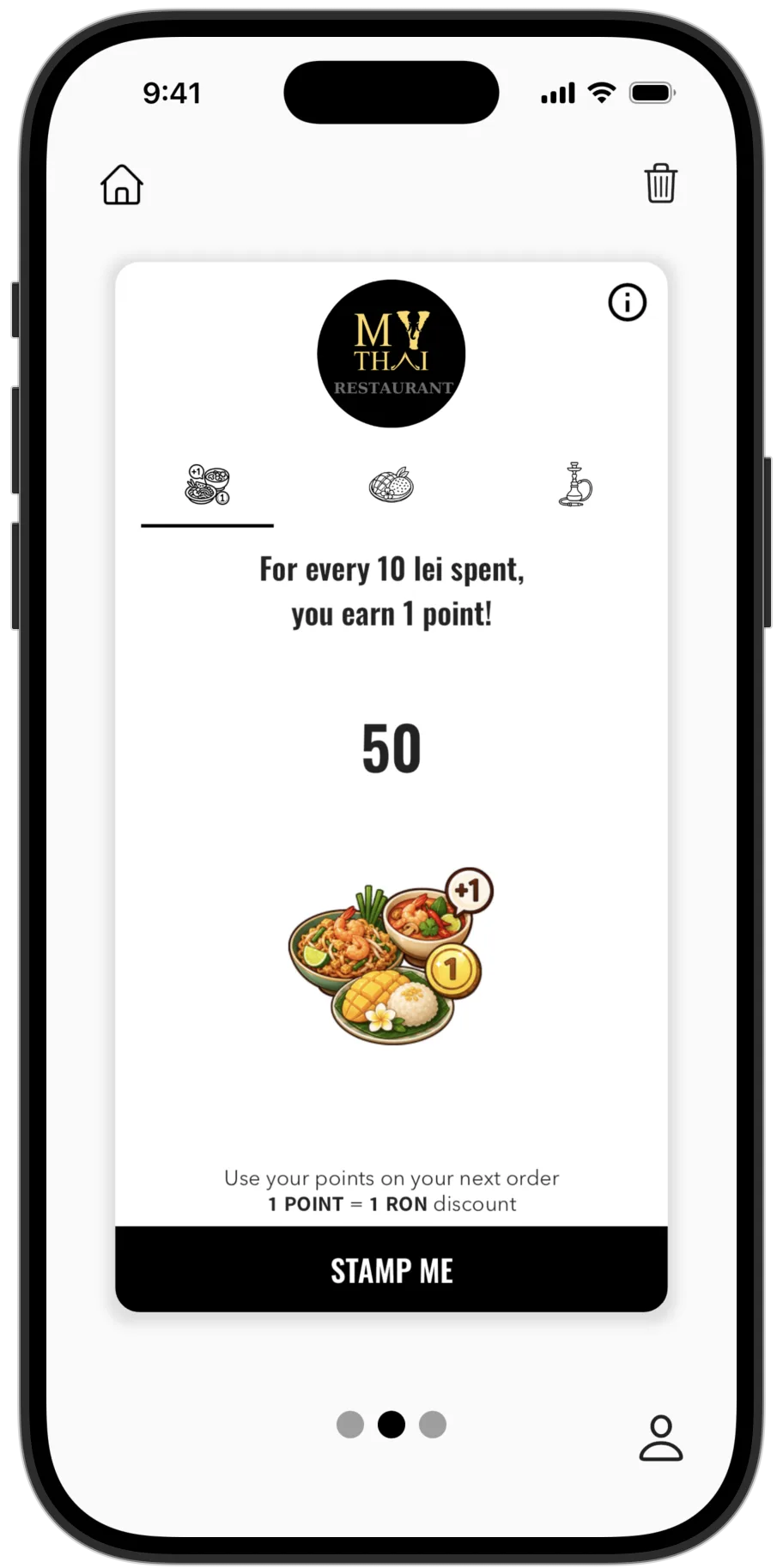
At My Thai, a restaurant in Cluj-Napoca, points are awarded on the value of the bill: for every 10 EUR spent the customer receives 1 point, and 1 point is worth 1 EUR off the next order.
Why it works in a restaurant:
- It applies to the whole bill, so the customer has nothing to remember about what counts and what does not.
- The simple ratio between a point and its value makes the mechanism easy to explain, with no discussion at the table.
- Points are spent on the next order rather than the current one, so there is a reason to return.
The simplest moment to scan the card is when the bill is settled, not when the order is taken.
Three offers on one card, and why they complement each other
Points are not the only offer at My Thai. Three run in parallel on the same card:
- Collect points: 1 point for every 10 EUR, and 1 point is worth 1 EUR off the next order. It applies to the whole bill.
- Dessert: every 3 visits, a dessert on the house. A stamp card, with a 56-day term.
- Shisha: after 5 orders, the sixth is on the house.
The combination works because points and stamps measure different things. Points reward the value of the bill, stamps reward the frequency of visits. Someone who walks in once and leaves 60 EUR and someone who comes three times and leaves 20 are both valuable, and a single offer would not cover both.
The dessert card is the one that brings the visit. It fills in 3 visits, not in 10, so the customer sees it close to complete from their second meal. And a dessert means the cost of the ingredients, not the menu price, so a low threshold here costs less than it appears and is perceived as more generous than an equivalent discount on the bill.
The 56-day term on the dessert card is what keeps it moving: three visits in two months means a customer who eats out every two or three weeks reaches the reward without rushing, while a customer with low frequency does not accumulate a card they would use a year later.
Shisha is the third offer because it carries a good margin and has its own return rhythm: customers who order it order it on almost every visit, so a 5+1 card fills naturally.
What is worth taking from this setup: each offer speaks about something else. They do not cannibalise one another, and the customer does not have to choose, because all three accumulate in parallel, from the same bill.
The number of offers depends on the plan. My Thai currently uses three offers, although their plan allows four.
You can also set an expiry period
You can leave the offer with no expiry, or set a term in days, weeks or months. The term appears on the customer's card.
When the term passes, the card resets and the customer starts from zero.
The customer is informed automatically 7 days before and once more the day before expiry.
In a restaurant, where visits are less frequent than in a coffee shop, a term that is too short can have the opposite effect to the one intended: the customer loses their progress right before using it. Unless you have a clear reason, leave the offer with no expiry.
Expiry comes with the Standard plan and up.
Loyalty card for restaurants: how to start
The customer installs the free Stampino app once, from the App Store, Google Play or AppGallery, searches for your place and receives the card. No account, no email and no password are required. The card can also be kept in Apple Wallet or Google Wallet.
When the bill is settled, the customer holds out their phone along with their bank card. You scan the code on the screen and the points arrive immediately.
The cost of the plan does not grow with the number of enrolled customers, so a month with many sign-ups does not cost more.
In 2025, the 78 partner businesses had 57,210 active customers on Stampino.
Adoption of the program also depends on staff involvement: where every bill comes with the question of whether the customer has the card, and those who do not have it are invited into the loyalty program, results appear much sooner.
What it costs and how the investment is recovered
A plan with a listing in the Stampino app starts at 36.50 EUR a month, plus VAT where applicable.
An indicative example: a bill of 24 EUR can leave a different available margin, depending on the cost of the ingredients and on the cost structure of the restaurant. If the remaining margin is around 16 EUR, a few additional bills in a month can cover the cost of the subscription.
A small number of additional receipts can therefore cover the cost, and the real result shows in the reports after the first month.
The birthday reward

Happy birthday!
A dessert on the house today. We have a table waiting.
The birthday reward appears on the card automatically, on the day itself. You keep no dates in a calendar and have nothing to remember.
In a restaurant, a birthday is one of the few occasions when the customer does not arrive alone. That makes the reward worth designing as a reason to book, rather than as a small gift:
- A dessert or a slice of cake on the house, on the day itself. It means the cost of the ingredients, and it is noticed at the table.
- A whole cake, if they come with a group. A cake for a group can turn the reward into a reason to book.
The group version is the one that changes the arithmetic: a dessert brings one customer, while a cake brings a whole table and, usually, a few new customers who see what your program looks like.
You can set a window in which the reward can be claimed, rather than the exact day. If the customer is away on their birthday the reward is not lost, and you have a reason for a booking the following week.
The birthday reward comes with the plans that list you in the Stampino app.
Push notifications to your own customers
Today's menu
Tom Yum soup and chicken pad thai, until 4pm.
Notifications reach the phone screens of people who have already signed up. You do not pay for advertising and you do not depend on who sees a post.
What is worth sending in a restaurant: the daily menu, a new dish on the list, holiday opening hours, an evening with live music.
Messages with no information reduce the open rate of the ones that follow.
Set up the offer for your restaurant
You choose the offer type, the value of a point and the reward in the admin panel, and you can change them after the first few months based on the reports. Scanning is done with the phone or tablet you already have, and the cost of the plan does not grow with the number of enrolled customers. Restaurants using Stampino include My Thai.
Set up your loyalty programFrequently asked questions
Points or stamps for my restaurant?
In many restaurants, points are the more suitable option. Bills vary a lot, and a stamp gives the same thing to a customer with a small order and to one with a bill several times larger. Stamps remain suitable if you sell a single repetitive product, for example a fixed-price lunch to go.
Set up your loyalty programWhat cashback percentage should I set?
10% can be a starting point, that is 1 point for every 10 EUR spent, if the points are spent on what you cook or prepare yourself. Choose 5% if they can also be spent on bottled drinks or packaged goods, then adjust to the real margin.
Does the customer need to create an account?
No. The app asks for no account, email or password. The customer installs it, searches for your place and gets the card, and the progress is tied to their phone. If they want, they can link an account later with Apple, Google or Facebook.
How does a customer add the card?
Two ways. The quickest: they scan the sign-up QR code you put on the counter, on the table or in the window, and the card lands on their phone in a single scan, with nothing to search for. Otherwise they install the Stampino app, search for your business and get the card there. The sign-up QR code comes with the Standard plan and up, and the poster and sticker are generated from the admin panel.
I also run a shop, not just the restaurant. Same setup?
Broadly the same: points there too. What differs are the thresholds, because in a shop the margin is thinner and it is usually the product that is counted, not the bill. We wrote about that separately in the loyalty program for stores.
Do I need a scanner or a new till?
No. You scan the QR code on the customer's screen with the phone or tablet you already have. Nothing changes at the till.
Is the QR menu included?
Yes. The QR menu is included free from the Standard loyalty plan up, or with the Lite Plus wallet plan. It can also be bought on its own, if you only want the menu.
See all plansCan I run several offers at once?
Yes, and in a restaurant it is usually the better option. My Thai runs three on the same card: points on the value of the bill, a dessert card at 3 visits and a 5+1 shisha card. Points reward the value of the bill, stamps reward the frequency of visits, and the customer accumulates all three from the same bill. The number of offers depends on the plan.
Do points expire?
Only if you choose that. You can leave the offer with no expiry or set a term in days, weeks or months. The term appears on the customer's card, and when it passes the card resets. In a restaurant, where visits are less frequent than in a coffee shop, no expiry is usually the better choice. Expiry comes with the Standard plan and up. The customer is informed automatically 7 days before and again the day before.
How much does it cost?
A plan with a listing in the Stampino app starts at 36.50 EUR a month, plus VAT where applicable. If you only want the card in Apple Wallet and Google Wallet, without the app listing, the Lite plan costs 10 EUR a month, plus VAT where applicable, but with a single offer and without the birthday reward.
See all plansSee also coffee shops, stores, salons, gyms, car washes, wallet-only card, apps for coffee shops, digital or punch cards, common mistakes, 20 loyalty program ideas, customer retention, features or the digital QR menu.