
Loyalty card for coffee shops

Happy birthday!
There is a coffee on the house for you today. Come and get it.
Here the customer comes often and buys much the same thing, so stamps are usually the suitable choice. Points come into play once you also sell brunch or bags of beans.
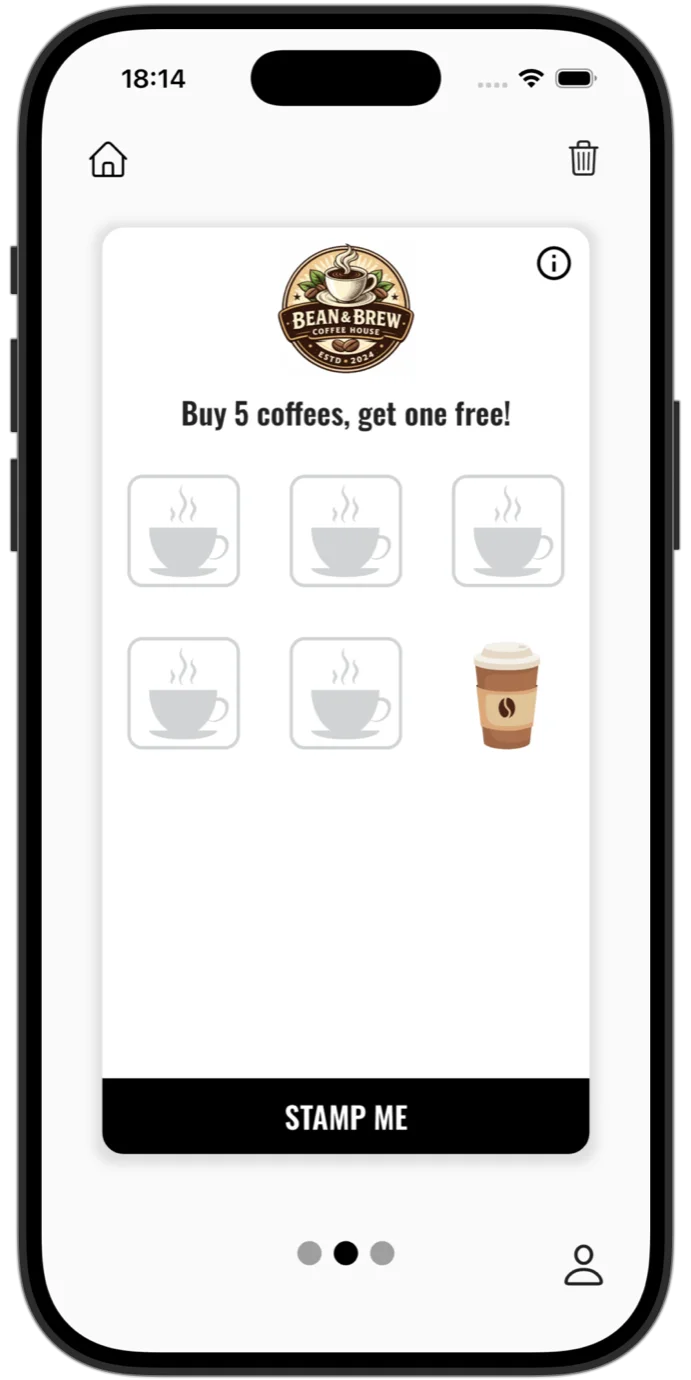
- 5+1 on coffee. One stamp per coffee, the sixth on the house. One of the most used setups in specialty and takeaway. As an indicative example: at two visits a week, the reward arrives in about two weeks.
- 9+1, at high traffic. Same mechanic, double the threshold. It suits businesses where many customers come several times a week, otherwise the card can stay unfinished.
- Coffee or cake, their choice. You can add several reward types to one offer and let the customer pick when they reach the threshold. It can be useful if you want to put desserts forward, without giving two rewards.
- Cashback 10%. One point for every 10 EUR spent, one point worth one euro. Right if you also sell brunch, cakes or beans, where bills vary a lot.
- An upgrade instead of a product. The reward is plant milk, an extra shot or the syrup of their choice. You usually charge for those, so the customer perceives a real gain, while your cost is lower than the surcharge you usually collect.
- Coffee of the month. The reward is the seasonal coffee, not the house one. That way you can also use the program for tasting, not only for giveaways.
- The birthday reward. It appears automatically on the card on the day itself and is collected within the window you set. You keep no dates in a calendar.
The setups and the thresholds by visit frequency are covered on the coffee-shop page.
Loyalty card for restaurants
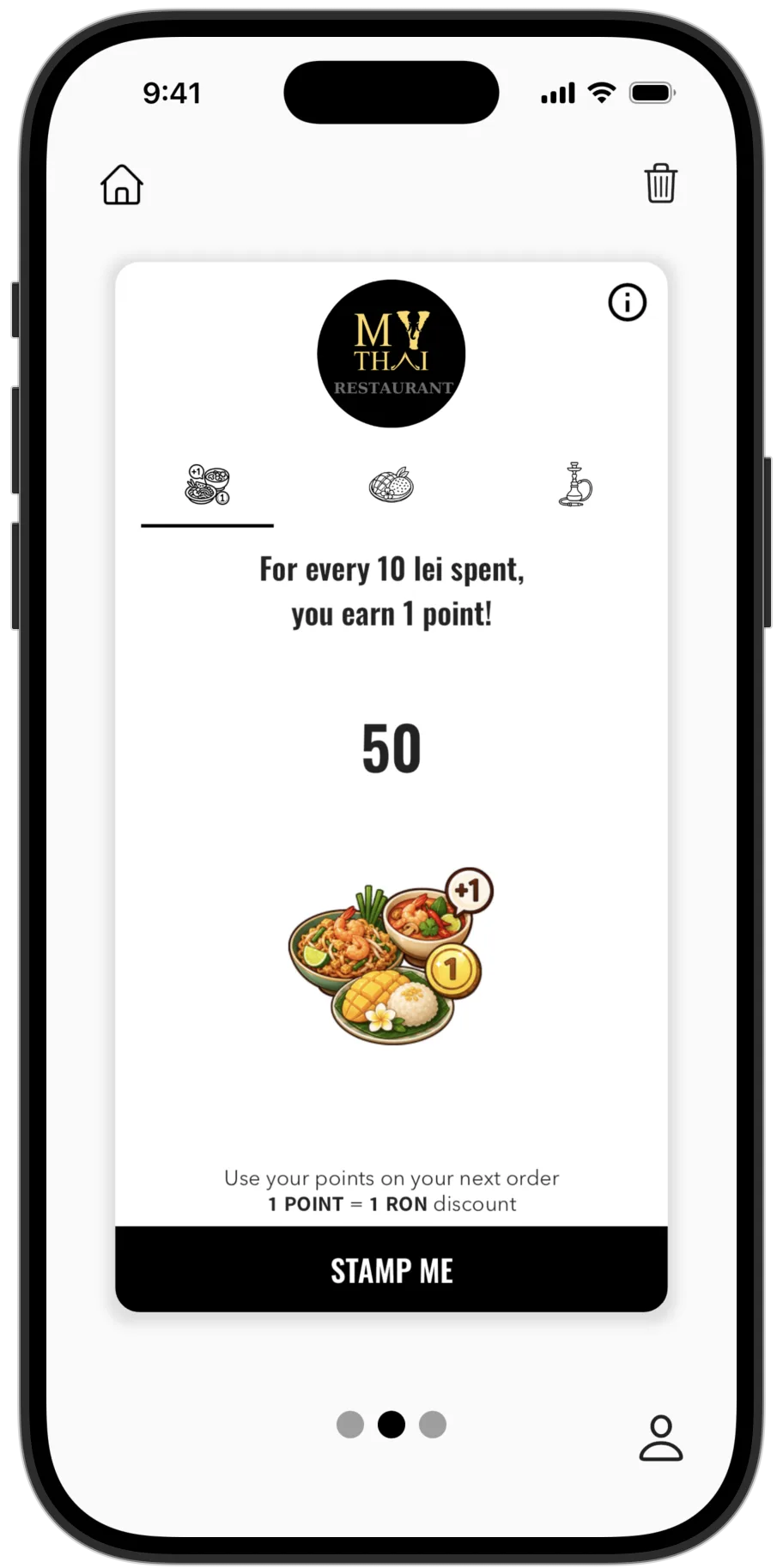
In a restaurant bills vary a lot and visits are less frequent. Points offers reward in proportion, which a stamp cannot do.
- 1 point per 10 EUR, 1 point = 1 EUR. The setup My Thai runs in Romania, in lei. It explains itself in one sentence and applies to the whole bill, so the customer does not have to remember what counts and what does not.
- Cashback 5%, when points go across the whole menu. Half a point per 10 EUR. The careful version if the reward can also be spent on bottled drinks, where the margin is small.
- Dessert or soup, their choice. Add two or three reward types to the same offer and let the customer pick. All of them are things you cook, so the reward means the cost of the ingredients.
- A minimum before redeeming. You set how many points must be collected before the reward can be used, so it is not spent 50 cents at a time on every visit.
- Two offers on one card. Lunch on stamps and the rest of the menu on points, in the same place. How many offers you get depends on the plan.
- Rewards saved for later. The customer keeps a reward they have earned instead of using it immediately, and you cap how many they can hold. Comes with the Premium plan.
How these look in practice, at My Thai and MINI STOP 24, is on the restaurants and shops page.
Loyalty card for shops
MINI STOP 24
You're nearby! Come say hi 👋
In a shop the margin is smaller and part of the shelf is resold stock. What matters here is less how much you give and more what you give it on.
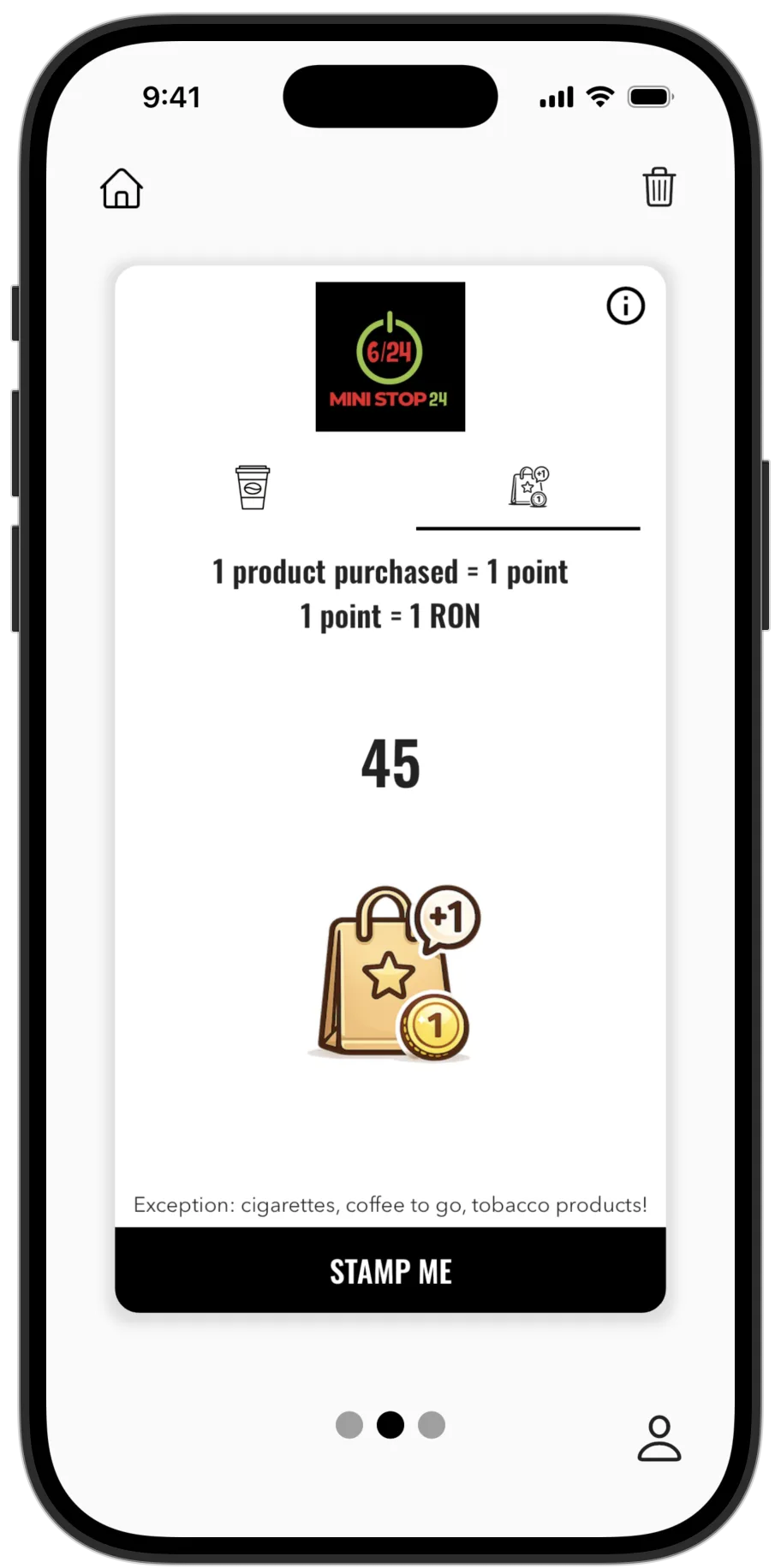
- 1 point per product. One product bought is one point, and one point is worth one leu. The MINI STOP 24 setup, easier to explain at the till than a percentage.
- No-margin categories taken out. Cigarettes, tobacco, takeaway coffee. The rule is printed on the card and applied at the till, so points are not accumulated on products with a very small margin.
- A minimum value per product. MINI STOP 24 asks for at least 5 lei, so that points are not accumulated on the small items at the till.
- A double-stamp or double-point day. You pick the day and the till gives two instead of one on each purchase. It is not a scheduled rule, you start and stop it yourself, which makes it usable for launching a new product or for days with low traffic.
- The reward picked off the shelf. Add several reward types and let the customer choose. It can also help with the products that turn over more slowly.
- No expiry at all. In a convenience shop, where visits are irregular, expiry can have the opposite effect to the one intended. You can leave it off.
- The card in the digital wallet. No app to install, and the card can appear on the lock screen when the customer is nearby. The detail is on the wallet-only card page.
Stamps or points
Stamps can be a starting point if you sell the same product many times at a similar price and customers come back often. The rule explains itself in one sentence and is easy to remember.
Points can be a starting point if bills differ a lot from each other, or if you have many products, because the reward then grows with what the customer spends.
A practical benchmark: if your usual big bill is more than three times your usual small one, a stamp under-rewards the customer who brings in the most.
Our starting recommendations
- Coffee shop: 5+1 on coffee, with a choice between the coffee and an upgrade.
- Restaurant: 1 point per 10 EUR, with the reward being something you cook.
- Shop: a point per product, with the no-margin categories removed and a minimum value per item.
All of it changes from the panel at any time, and customers keep their progress. Your first setup is not final, so it is not worth hunting for the perfect one before you start.
Set one of them up
You choose the offer type, the threshold and the reward in the admin panel, and customers get the card in their phone. You can change the setup at any time without replacing the cards already issued.
Set up your loyalty programFrequently asked questions
Can I run two offers at the same time?
Yes, on the same card, and the number depends on the plan. In a coffee shop a common combination is stamps on coffee and points on the rest of the menu. Or two offers by category: one on coffee, one on cakes.
Set up your loyalty programCan I give several reward types on the same offer?
Yes. You add several reward types to the offer and the customer picks when they reach the threshold. That covers different tastes without giving two rewards.
How do I exclude products I have no margin on?
You write the rule on the card and it is applied at the till. MINI STOP 24 has exactly two lines: no cigarettes, tobacco or takeaway coffee, and a minimum product value of 5 lei.
What if I pick the wrong offer?
You change it from the admin panel at any time. The offer type, the threshold, the reward and the expiry period can all be modified without losing customers or their progress.
How much does it cost?
A plan with a listing in the Stampino app starts at 36.50 EUR a month, plus VAT where applicable. If you only want the card in Apple Wallet and Google Wallet, the Lite plan costs 10 EUR a month, plus VAT where applicable. The cost of the plan does not grow with the number of enrolled customers.
See all plansSee also coffee shops, restaurants, stores, salons, gyms, car washes, wallet-only card, apps for coffee shops, digital or punch cards, common mistakes, customer retention, features or the digital QR menu.