
What a loyalty program changes in a coffee shop
Paper punch cards can be lost or damaged, and they do not give you data about customer behaviour.
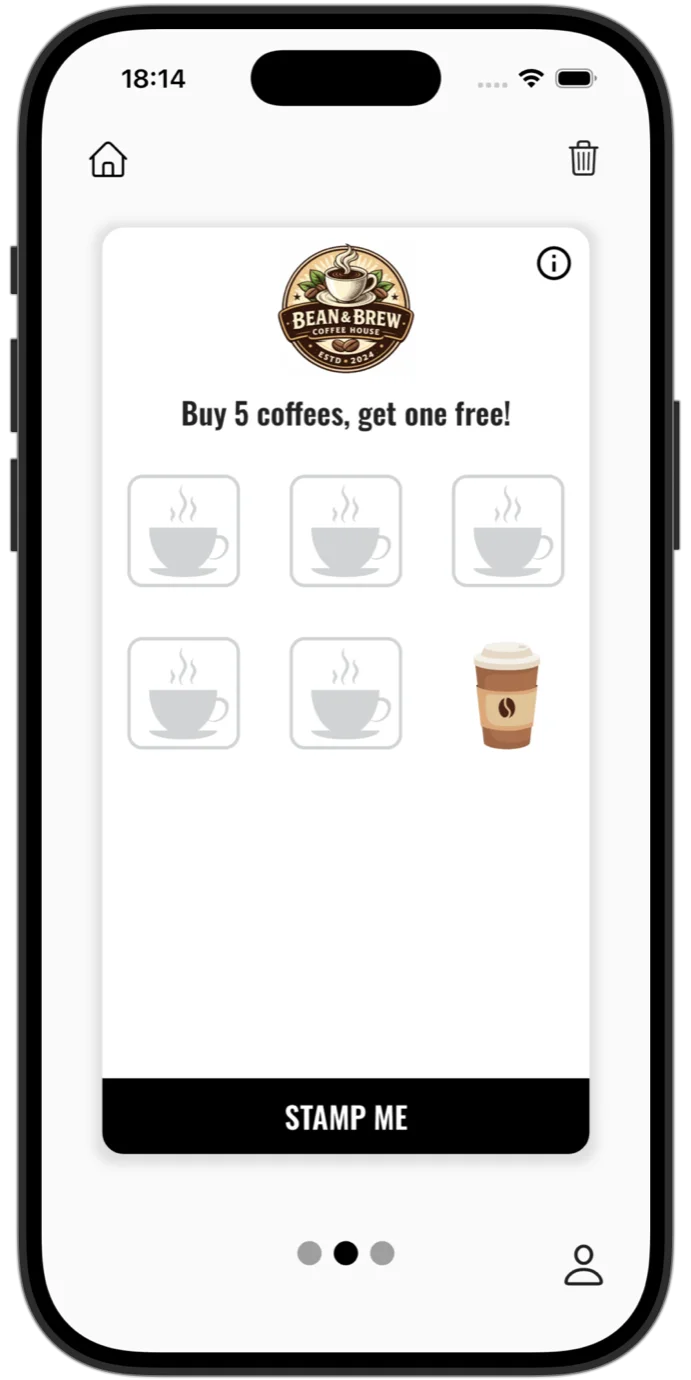
Stampino moves the card into the phone. The customer opens the card, you scan it, the stamp is added. No manual handling of paper cards and no reprints.
You have two offer types: stamps and Cashback on a points basis. Which one fits depends on how often the customer comes in and on how much your bills vary.
In the reports you see how many customers signed up, how many visits were recorded and how many rewards were claimed, so you can adjust the offer on the basis of the data.
Some loyalty solutions limit the number of cards or customers, and some even limit the number of stamps or points you are allowed to give. Stampino does not limit the number of enrolled customers on these plans, so a month with many sign-ups does not cost more.
In 2025, the 78 partner businesses together handed out 636,299 stamps and 129,954 rewards, to 57,210 active customers.
The stamp offer: 5+1 or 9+1
With 5+1, the sixth coffee is on the house. With 9+1, the tenth.
After the threshold is reached, the reward appears automatically on the card, you scan it and hand over the coffee on the spot. The claiming process is simple, with no extra steps.
The difference that matters is not the price, it is how fast the customer reaches the reward. If the reward comes quickly, the offer becomes easier to remember. If it takes two months, the card loses its relevance.
How long it takes, by how often they come in:
- Three times a week: 5 stamps in two weeks, 9 in three. Either one works.
- Twice a week: 5 stamps in two and a half weeks, 9 in four and a half.
- Once a week: 5 stamps in five weeks, 9 in nine. Only 5+1 makes sense here.
For many coffee shops, 5+1 can be a good starting point. The reward is given more often, but in exchange the offer stays visible to the customer.
A stamp does not depend on how much the customer spent, and the rule explains itself at the counter in one sentence.
Cashback on a points basis: when it is more suitable than stamps
With Cashback, the customer accumulates points on the card, and one point is worth one euro. You choose the pace: 1 point for every 10 EUR spent, which is 10%, or half a point, which is 5%.
It fits when your bills vary a lot, because you also sell brunch, cakes, bags of beans, or orders for two and three people.
With stamps, an espresso and an 18 EUR order receive the same thing: one stamp. With Cashback, the large order accumulates in proportion to its value.
Any product added to the order raises the amount accumulated, so the customer has one more reason to take the cake as well.
One single thing to watch: what the accumulated points can be spent on. On drinks you make yourself, the reward amounts to the cost of the raw materials. On bottled or packaged goods, where the margin is small, the same value costs you far more. If you sell a lot of those, choose 5%.
If you are starting from scratch, begin with stamps, because they are simpler to explain. If your till receipts show you that the bills vary a lot, move to Cashback. You can also run both on the same card, depending on your plan.
What a free coffee actually costs you
The direct cost of a coffee varies with the beans, the size, the milk and the packaging. As an order of magnitude, a coffee sold at 3.50 EUR usually means between 0.80 and 1.20 EUR of direct cost.
The real cost of the reward is close to the production cost, not to the selling price.
The reward is therefore supported by the raw materials. That is why one coffee on the house for every five sold can be supported by the product margin.
Put your own figures in and you can see the result for your coffee shop straight away.
How to choose the threshold and the reward
The threshold is chosen by how often the customer comes in, not by how much you are willing to give away. The rule of thumb: a regular customer should reach the reward in about four weeks.
- Three times a week: 8 to 10 stamps.
- Twice a week: 6 to 8.
- For customers who visit less often, a lower threshold may be more suitable, around 4.
Rewards with a low direct cost:
- Your standard coffee. It is also the product the customer comes back for, so the reward reinforces exactly the habit you want.
- Plant milk, an extra shot, the syrup of their choice. You charge for these separately, so the customer perceives a real gain, while it costs you less than the surcharge you normally collect.
Rewards to avoid:
- A branded mug or any promotional object: promotional objects have a direct purchase cost.
- A discount on the whole bill, because it also covers the items with a small margin.
- Resold goods: bottled drinks, packaged snacks. There the selling price sits close to the cost.
After the first month, look at the reports. If stamps go up but rewards stay flat, the threshold is too high and too few customers reach the end. You change it from the admin panel.
You can also set an expiry period
You can leave the offer with no expiry, or you can set a limit: in days, weeks or months. The limit shows on the customer's card, so they can see how long they have.
When the limit passes, the card resets and the customer starts from zero, with the next scan landing on the new card.
The customer is informed automatically 7 days before and once more the day before expiry.
A short limit creates a reason to come back. Too short, though, and the customer loses the progress and gives up on the card.
Choose it the way you choose the threshold: leave enough time to reach the reward at their usual pace, plus a margin. At two visits a week and a threshold of 6 stamps, two months is a generous limit, while two weeks is too restrictive.
Expiry comes with the Standard plan and up.
Loyalty card for coffee shops: how it works day to day
The customer installs the free Stampino app once, from the App Store, Google Play or AppGallery, searches for the coffee shop and gets the card on the spot. The coffee shop's loyalty card can also be kept in Apple Wallet or Google Wallet.
On each order the customer opens the card and turns the screen towards you. You scan the code with the phone on the counter, during the normal serving process.
The program on its own does not bring customers back. It needs an offer the customer actually wants, and people at the counter who ask on every order whether they have the card, and who invite the ones who do not into the loyalty program.
At Cafizzio, Nish Coffee, Mabo Coffee, Tamper Coffee and many other coffee shops, the card is already in the customers' phones.
What it costs and how the investment pays back
A plan with a listing in the Stampino app starts at 36.50 EUR a month, plus VAT where applicable.
The following example is indicative: if a coffee generates around 2.40 EUR after the cost of the ingredients, the subscription can be recovered through about 19 extra coffees in a month, which is roughly two coffees every three days. The real result depends on each coffee shop's costs.
Above that line, everything the program brings in remains gain. And if you do not reach it, the reports show you after the first month, not after a year.
Push notifications and the birthday reward

Ethiopian filter, today
Ethiopian filter on the bar until midday. Come and try it.
Push notifications land on the phones of the customers who signed up. You do not pay for advertising and you do not depend on social networks to get a message across.
Only send when you have something concrete to say: a new product on the bar, holiday opening hours, a change of schedule. Messages with no information in them lower the open rate of the ones that follow.
The birthday reward activates automatically. It appears on the card on the day itself, and it is claimed at the counter within the window you set. You keep no dates in a calendar.
Set up the offer for your coffee shop
You choose the offer type, the threshold and the reward in the admin panel, and you can change them after the first few months, on the basis of the reports. You scan with the phone or tablet in the shop.
Set up your loyalty programFrequently asked questions
Which offer should I choose at the start, 5+1 or 9+1?
For many coffee shops, 5+1 is a good starting point. The customer reaches the reward almost twice as fast, so the offer stays visible. With 9+1 the reward is given less often, but a customer who comes once a week may never reach the threshold.
Set up your loyalty programDoes the customer need to create an account?
No. The app asks for no account, no email address and no password. The customer installs it, picks your coffee shop and gets the card, and their progress is tied to their phone. If they want, they can link an account later with Apple, Google or Facebook.
How does a customer add the card?
Two ways. The quickest: they scan the sign-up QR code you put on the counter, on the table or in the window, and the card lands on their phone in a single scan, with nothing to search for. Otherwise they install the Stampino app, search for your business and get the card there. The sign-up QR code comes with the Standard plan and up, and the poster and sticker are generated from the admin panel.
Which stamp threshold should I choose for my coffee shop?
Choose a threshold your regular customer reaches in about four weeks. For many coffee shops that means 5+1.
When is Cashback more suitable than stamps?
When your bills vary a lot, because with stamps an espresso and a large order receive the same single stamp. If you sell almost nothing but coffee, stay on stamps, because they are simpler to explain. You can also run both on one card, depending on your plan.
What cashback percentage should I choose?
Start at 10%, that is 1 point for every 10 EUR spent, if the points are used on drinks you make yourself. If they can also be used on food or on bottled goods, where the margin is small, choose 5%.
Does the customer need an app, and do I need a scanner?
The customer installs the free Stampino app once, from the App Store, Google Play or AppGallery, searches for the coffee shop and gets the digital loyalty card, which can also be kept in Apple Wallet or Google Wallet. You scan the QR code from their screen with the phone or tablet in the shop, with no extra hardware. The cost of the plan does not grow with the number of enrolled customers.
Do stamps expire?
Only if you want them to. You can leave the offer with no expiry or set a limit in days, weeks or months. The limit shows on the customer's card, and when it passes the card resets and the customer starts from zero. Expiry comes with the Standard plan and up. The customer is informed automatically 7 days before and again the day before.
Is the QR menu included?
Yes. The QR menu is included free from the Standard loyalty plan up, or with the Lite Plus wallet plan. It can also be bought on its own, if you only want the menu.
See all plansHow much does it cost?
A plan with a listing in the Stampino app starts at 36.50 EUR a month, plus VAT where applicable. If you only want the card in Apple Wallet and Google Wallet, the Lite plan costs 10 EUR a month, plus VAT where applicable, but there you have a single offer, you are not listed in the app and you do not have the birthday reward.
See all plansSee also restaurants, stores, salons, gyms, car washes, wallet-only card, apps for coffee shops, digital or punch cards, common mistakes, 20 loyalty program ideas, customer retention, features or the digital QR menu.