What you stamp in a gym: the counter, not the entries
This is the most important decision on this page, and it is an easy one to get wrong.
The first idea is usually to stamp entries: ten workouts, one free. It sounds logical, but it has two weak points.
First, attendance is already paid for. The member paid for the month, and the reward would repay behaviour that happens anyway. Second, the reward on an entry card usually means free gym time, which is the exact service the business runs on. In practice you reduce the value of the membership to reward a member who was already paying.
At the counter the situation is the opposite. The shake after training, the bar, the coffee: each is a separate decision taken dozens of times a month, and the alternative is not skipping it, it is bringing it from home or buying it at the shop round the corner. That is where a card does move behaviour, because the program works as a customer return system rather than only a collection of stamps.
The rhythm is also suited to stamps. A member who trains three times a week and takes a shake afterwards completes a five-stamp card in about two weeks. Few types of business have a comparable visit frequency.
Big Fitness Cluj-Napoca: three offers on one card
Big Fitness is a gym in Cluj-Napoca, in the WINMARKT complex on Bucegi street. Here is how their loyalty program is configured in Stampino:
- Protein bar: buy 7, get 1 free.
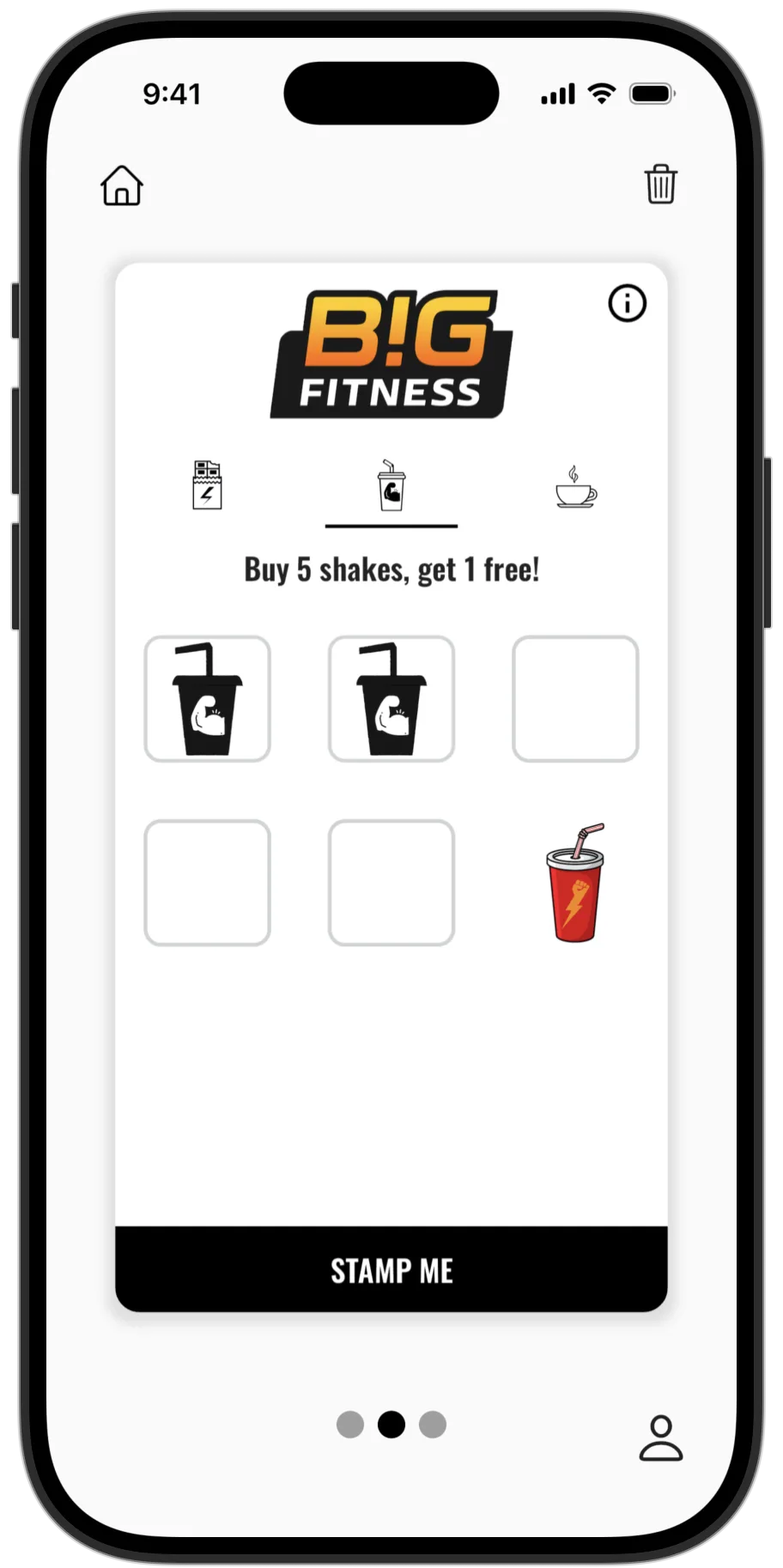
- Shake: buy 5, get 1 free.
- Coffee: buy 5, get 1 free.
All three sit on a single card and the member switches between them directly on the card, as in the image next to the title. It is not three cards to keep track of, but one card with three rows of stamps that advance independently.
Entry to the gym is not stamped. The membership stays a membership, and the loyalty program stays entirely at the counter.
The configuration above is their choice, suited to their products and their frequency. The general recommendation stays the same for any gym: pick the threshold according to what the reward costs you and how often the product is bought, then adjust on the basis of the reports.
They currently use three offers, although the plan allows four. The fourth can be used for a new product, without changing the offers that already work.
Why different thresholds for different products
Their numbers are worth looking at again: 7 on bars, 5 on shakes, 5 on coffee. That is not an inconsistency, it is the idea behind the configuration.
The threshold is chosen by what the reward costs you and how often the product is bought, not by the product itself. The bar is the cheapest of the three and is bought most often, so it carries a higher threshold without the member feeling they may not reach the end. The shake has the highest price of the three, so its reward is more suitable after a smaller number of purchases.
A practical benchmark: pick the threshold so the reward is reached about once a month by a member who comes regularly. Someone taking a shake after every session, two or three times a week, reaches 5 in two or three weeks. Someone buying bars more often reaches 7 in roughly the same interval.
That way all three offers complete at about the same rate even though the thresholds differ, and the member does not feel that one of them is stuck.
Loyalty card for a gym: how you start
At reception, which the member walks past anyway.
The first time: the member scans the sign-up QR code on the counter or at the entrance and the card lands straight on their phone, from a single scan. No account, no email, no password. The card can be kept in the Stampino app or directly in Apple Wallet and Google Wallet.
After that, on every purchase: the member opens the card, picks the offer directly on the card, and you scan the code on their screen with the phone or tablet at reception. No separate reader.
A gym has an advantage few businesses have: the same people, several times a week, for months. The sign-up does not have to happen on day one, because you get dozens of chances.
The reports show how many members signed up, how many stamps you gave on each offer and how many rewards were redeemed, so you can see in the data which product works and which does not.
Adoption of the program also depends on staff involvement: where every order at the counter comes with the question of whether the member has the card, results appear much sooner.
What it costs and how the investment is recovered
A plan with a listing in the Stampino app starts at 36.50 EUR a month, plus VAT where applicable.
A protein bar retails at roughly 2 to 3.50 EUR, and a gym counter sells it for more. The margin on a bar or a made-up shake is about a euro apiece.
As an indicative example: at a margin of around 1.20 EUR an item, the cost of the plan can be covered by roughly 37 additional items in a month, which is a little over one shake or one bar a day in a gym with a few hundred members. The real result depends on each business's costs.
These are not new members, but products that the members who already come buy from you instead of bringing them from home.
As with any calculation of this kind, what is left is margin over the cost of the product: rent, wages and utilities come out of it afterwards.
The birthday reward

Happy birthday!
There is a shake on the house for you today. Come by the counter after training.
In a gym it makes more sense than it first appears.
The reward appears on the card automatically on the day and is redeemed in the window you set. You keep no dates in a calendar and send nothing by hand.
In a gym a birthday is one of the few occasions where you speak to a member about something other than paying the membership. A shake on the house means a cost of around a euro and is remembered.
Push notifications to members
New shake at the counter
We added a peanut butter shake. Your first stamp counts on it too.
A gym has predictable slow periods: January is packed, July is empty, and in between are the weeks when some members drop off.
A notification reaches the phones of the members who hold the card, without depending on who happens to see your post. It is useful for a new product at the counter, a promotion running a few days, or an opening-hours announcement.
The cost of the plan does not grow with the number of enrolled members, so signing up the whole gym does not cost more.
You can also set an expiry period
You can leave the offer with no expiry, or set a term in days, weeks or months. The term appears on the member's card, and when it passes the card resets.
In a gym, pay attention to the summer. A member who comes regularly from September to June might miss four weeks in August, and a short term resets their card in exactly the period with lower takings.
If you set a term, three months can be a starting point. The member is informed automatically seven days before and once more the day before expiry. Expiry comes with the Standard plan and up.
Set up the offer for your gym
You pick the products, the threshold and the reward in the admin panel, and you can change them after the first few months based on the reports. You scan with the phone or tablet at reception, and the cost of the plan does not grow with the number of enrolled members.
Set up your loyalty programFrequently asked questions
What do I stamp in a gym?
What they buy at the counter: shakes, protein bars, coffee, not entries. Attendance is already paid for through the membership, and the reward on an entry card usually means free gym time, which is the exact service the business runs on.
Set up your loyalty programCan I put several offers on the same card?
Yes, and in a gym it is usually the better option. Big Fitness runs three on one card: bars at 7+1, shakes at 5+1 and coffee at 5+1, which is their choice. The member switches between them directly on the card and each advances separately. The number of offers depends on the plan.
See all plansWhat threshold do I pick for each product?
Pick it so the reward is reached about once a month by a member who comes regularly. Cheaper items bought more often carry a higher threshold, and pricier ones need a lower one. Big Fitness runs 7 on bars and 5 on shakes, which can be a starting point.
Does it work on memberships or personal training sessions?
It can, but the cost of the reward is worth working out. A free session with a trainer is an hour of their schedule, not a consumable, so the reward costs you an employee's time. If you want to reward membership loyalty, something from the counter means a cost of around a euro and is perceived similarly.
Does the member need an account?
No. There is no need for an account, an email or a password. The member scans the QR code at reception, the card lands on their phone and progress stays tied to the phone. They can keep the card in Apple Wallet or Google Wallet too. If they want, they can link an account later with Apple, Google or Facebook.
Do I need a scanner?
No. You scan the code on the member's screen with the phone or tablet at reception. The cost of the plan does not grow with the number of enrolled members.
What do I do about the summer months?
If you set an expiry period, three months can be a starting point, so that an August break does not reset the card of a member who comes all year. You can also leave the offer with no term.
What does it cost?
A plan with a listing in the Stampino app starts at 36.50 EUR a month, plus VAT where applicable. If you only want the card in Apple Wallet and Google Wallet, the Lite plan costs 10 EUR a month, plus VAT where applicable, but there you get a single offer, no listing in the app and no birthday reward.
See all plansSee also coffee shops, restaurants, stores, salons, car washes, wallet-only card, apps for coffee shops, digital or punch cards, common mistakes, 20 loyalty program ideas, customer retention, features or the digital QR menu.