Why the big chains invest millions in loyalty
Lidl Plus, Tesco Clubcard and Carrefour's loyalty card are not marketing campaigns. They are infrastructure, built and maintained by whole teams, for a single objective: turning an occasional shopper into a customer who comes back.
All of them use roughly the same levers:
- Points or coupons accumulated on every purchase, redeemable later. The discount is not given immediately but on the next visit, precisely so that there is a next visit.
- Personalised offers, built from what the customer has bought so far. Someone who buys coffee every morning gets a coffee offer, not a detergent one.
- Push notifications on the phone, reaching people who already signed up, without paying for every impression.
- A digital card in an app, so nothing depends on a paper card, which can be lost or damaged.
The logic behind it is simple and has nothing to do with the size of the business: a customer who has accumulated value with you has a reason to come back. A customer with nothing accumulated decides from scratch every time, on price or on which door is closer.
The difference between a chain and a corner store is not the principle, it is the budget. A local store can rarely afford to build its own mobile app, but it can reach the same objective with a digital loyalty platform like Stampino.
Why points work better than stamps in a store
A stamp is a fixed unit: one visit, one stamp. It works very well in a coffee shop, where everyone buys roughly the same thing at roughly the same price, and the tenth coffee is the same size as the first.
In a store the situation is different. One customer picks up a loaf of bread, another does the shopping for the whole week. On stamps they both get the same thing, and the customer who spent 200 notices that they are treated the same as the one who spent 5.
Points offers fix that with a single setting. The customer accumulates in proportion to the value of the purchase and spends the points on a later visit. Customers with larger baskets accumulate proportionally more rewards. In Stampino, the variant that is calculated on the bill value is also called Cashback.
There is a second advantage that shows after a few months: the accumulated value stays within your relationship with the customer. A discount applied immediately is consumed and ends there, while points on the card are a reason to return, because they can only be used within your business.
MINI STOP 24: points per product, plus a coffee-only card
MINI STOP 24 is a 24-hour store in Piatra Neamț, Romania, with four locations on the same card. Their setup is interesting because it runs two offers in parallel, not one.
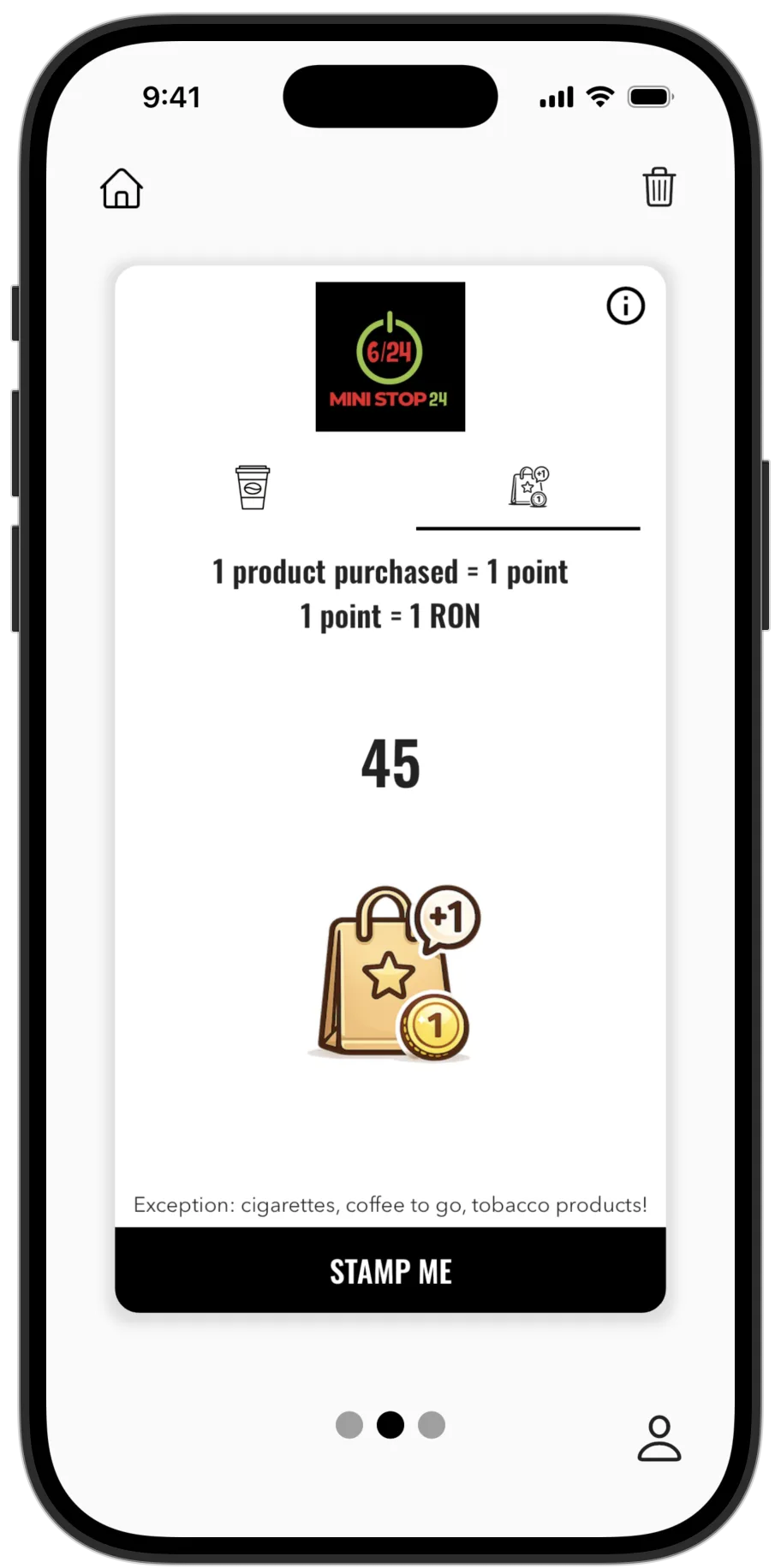
The first is the points offer, for the whole store: 1 product purchased means 1 point, and 1 point is worth 1 leu. The product is what counts, not the value of the bill.
What makes the offer work in a store are the two rules printed on the card itself, right under the offer:
- Exceptions: cigarettes, tobacco, coffee to go. These are the categories where the margin is small or regulated, and without that line the reward would reduce exactly the profit they bring in.
- Minimum product value: 5 lei. Without it, a customer could accumulate points by repeatedly buying the cheapest item at the till.
The second offer is a classic stamp card, for coffee only: buy 5 coffees, get one free. Here the stamp is the suitable choice, because coffee is a product the same customer buys repeatedly, in the same quantity and at the same price.
The configuration above is their choice, suited to their range and their frequency. As a general structure, it can be a starting point for many stores with a coffee shelf or a machine: proportional points on everything you sell, plus a fixed card on the everyday item. Coffee is excluded from the points offer precisely because it already has its own card, so the customer is not rewarded twice for the same money.
The real advantage in retail is not the reward, it is frequency. A neighbourhood customer usually walks past you several times a week anyway. Points give them a reason to come in, not just to walk past.
How to configure an offer that stays profitable
You have two starting points, and both can be changed from the admin panel after the first few months, based on the reports.
By bill value: 1 point for every 10 euros spent, 1 point worth 1 euro. A 120-euro basket leaves the customer 12 euros for the next visit, which is 10% of the bill.
By product, as at MINI STOP 24: 1 product purchased equals 1 point, with a minimum value per product and the zero-margin categories taken out of the offer. Here you keep the full value of the point but narrow where it applies.
What the reward costs you depends on what the customer spends the points on. On resold goods, where the margin is small, the cost is close to the value on the card. Hence a few starting benchmarks:
- 5% can be a starting point if the points can be spent on anything in the store, including resold goods with a small margin.
- 10% is more suitable if they go on what you prepare yourself, where ingredients are only part of the price.
- Or the full value of the point, but with category exceptions and a minimum per product, the variant chosen by MINI STOP 24.
You can leave the offer with no expiry, or set a term in days, weeks or months. The term appears on the customer's card, and when it passes the card resets. The customer is informed automatically 7 days before and once more the day before expiry.
In a neighbourhood store, where the customer passes several times a week, a term makes sense and keeps the card moving. If visits are rare, too short a term can have the opposite effect to the one intended. Expiry comes with the Standard plan and up.
Why you do not need your own mobile app
Lidl, Tesco and Carrefour have their own apps because they have millions of customers and development teams. For a local store, the same route means two costs, and the second one is usually what blocks the project.
The first is development: an app for iOS and Android, plus maintaining it for every new OS version, plus the app store fees.
The second, and more difficult, is convincing the customer to install it. Few customers want one more app on their phone for a single store. An app installed by 40 people and deleted by half of them does not sustain a loyalty program.
With Stampino the customer has three routes, and none of them carries a development cost for you:
- Install the free Stampino app once, from the App Store, Google Play or AppGallery, and hold the cards of every business in the program there, not just yours.
- Or save the card straight into Apple Wallet, with no app at all.
- Or into Google Wallet, the same way.
You have no developer account, no versions to maintain and no per-customer fee. Some loyalty solutions limit the number of cards or customers, while Stampino does not limit the number of enrolled customers on these plans, and the cost of the plan does not grow with the number of enrolled customers.
POS integration
You can start with no integration at all: you scan the QR code on the customer's screen with the phone or tablet you already have, and the points land immediately. Nothing changes at the till.
If you have real volume at the checkout, integrating with the POS changes a few things:
- Points are calculated automatically from the receipt, so the process does not depend on what the person at the till remembers to do.
- The cashier does not hold a second device and does not step out of their usual flow.
- Manual entry mistakes are reduced, and in a store with a queue those add up.
- The queue moves faster, which in a 24-hour store at 8am matters more than the reward does.
Integration with POS systems is done through an API and comes with the Premium plan.
Push notifications to your customers

Fresh delivery just arrived
Warm bread and local dairy, from 7am.
Notifications land on the phone screens of people who already hold your card. You pay nothing for reach and you do not depend on who happens to see a post: a post on social media reaches a small share of your followers, while a notification reaches the customers who signed up.
What is worth sending from a store:
- The fresh delivery has arrived, on the morning it lands.
- The weekend offer, on Thursday or Friday.
- Holiday opening hours, when the whole street is wondering who is open.
- A new product on the shelf, if it is something customers were asking for.
- Seasonal campaigns: back to school, Easter, Christmas.
What is not worth sending: messages with no information. They reduce the open rate of the ones that follow, including the messages that matter.
The card in Apple Wallet and Google Wallet
The card can sit directly in the phone's wallet, next to the bank cards and boarding passes. For a store that matters more than it sounds, because it reduces exactly the friction at the till:
- The card is at hand, in the place where the customer already keeps what they pull out to pay.
- No account, no email and no password to remember.
- It opens with a single tap, without hunting for an app among others.
- It receives notifications even without the Stampino app installed.
At the till, the customer holds out the phone along with the bank card. You scan the code on the screen and the points land immediately.
Birthday rewards
Happy birthday!
A coffee on us today. Come by any time in the next 10 days.
The birthday reward appears on the card automatically, on the day. You keep no dates in a calendar and have nothing to remember.
At MINI STOP 24 the reward is a coffee, with a 10-day window in which it can be claimed. That is their choice. The window is the useful part: if the customer is away on the day itself, the reward is not lost, and you have one more reason for a visit the following week.
As a general recommendation, pick a reward with a low direct cost that brings the customer into the store, not one that covers their basket. The point is the visit, not the gift.
Birthday rewards come with the plans that list you in the Stampino app.
What it costs and how the investment is recovered
A plan with listing in the Stampino app starts at 36.50 euros a month, plus VAT.
In a store the margin is small, so the calculation works on what you earn, not on what you take.
As an indicative example: on an 8-euro basket that leaves around 1.60 euros after the cost of goods, around 28 additional baskets in a month cover the cost of the subscription, which is less than one a day. The real result depends on each business's costs.
In a neighbourhood store that already has daily footfall, the difference usually does not come from new customers but from the ones who used to walk into the neighbour's shop because it was more convenient.
If you only want the card in Apple Wallet and Google Wallet, with no listing in the app, the Lite plan costs 10 euros a month plus VAT, but with a single offer and no birthday reward. For the MINI STOP 24 setup, with two offers in parallel, you need a plan with listing.
How to start
You pick the offer type, the threshold and the reward in the admin panel, and the card is ready in a few minutes. Nothing is installed on the computer in the store.
The customer gets the card in two ways. The fastest: they scan the sign-up QR code you put at the till, on the window or on the shelf by the door, and the card lands straight on their phone in a single scan, with nothing to search for. Otherwise, they install the Stampino app and look up the store. The sign-up QR code comes with the Standard plan and up, and the poster and sticker are generated from the admin panel.
Adoption of the program also depends on staff involvement: where every receipt comes with the question of whether the customer has the card, and those who do not have it are invited into the loyalty program, results appear much sooner.
In 2025, the 78 partner businesses had 57,210 active customers on Stampino.
Conclusion
A modern loyalty program does not replace discounts and does not put you in a price fight with a chain. It is a customer return system: it gives the customer a reason to come back, and gives you a link to them that does not depend on who has the bigger sign in the window.
With proportional points, a card in Apple Wallet and Google Wallet, push notifications and POS integration, a neighbourhood store can offer an experience close to that of the big chains, without investing in an app of its own.
The MINI STOP 24 setup can be a starting point: points across the store, with the exceptions and the minimum threshold that protect your margin, plus a stamp card on coffee.
Configure the loyalty program for your store
You pick the offer type, the threshold and the reward in the admin panel, and you can change them after the first few months based on the reports. Scanning is done with the phone or tablet already in the store, and the cost of the plan does not grow with the number of enrolled customers. Stores using Stampino include MINI STOP 24, across four locations.
Set up your loyalty programFrequently asked questions
Points or stamps for my store?
In many stores, points are the more suitable option. Baskets vary a lot, and a stamp gives the same thing to someone who spent 5 and someone who spent 200. Stamps remain suitable for a single repetitive product, usually bought in the same quantity, such as coffee. At MINI STOP 24 both run in parallel: points across the store, stamps on coffee.
Set up your loyalty programWhat cashback percentage should I set in a store?
5% can be a starting point if the points can be spent on anything, including resold goods with a small margin. 10% is more suitable if they go on what you prepare yourself. A third option, chosen at MINI STOP 24: keep the full value of the point, but take the zero-margin categories out of the offer and set a minimum value per product.
How do I protect my margin on cigarettes and no-profit products?
Take them out of the offer. At MINI STOP 24 the exceptions are cigarettes, tobacco and coffee to go, and that line appears on the customer's card right under the offer, so it is not a surprise at the till. You can also set a minimum value per product, 5 lei in their case, so that points are not accumulated by repeatedly buying the cheapest item at the till.
Is this the same as Lidl Plus or Tesco Clubcard?
The principle is the same: the customer accumulates on every purchase and spends later, and you can send offers straight to their phone. The difference is that the chains built their own apps with development teams, while you start on an existing platform, with no development cost and without convincing customers to install an app for a single store.
Does the customer need an account?
No. The app asks for no account, no email and no password. The customer installs it, looks up the store and gets the card, and progress is tied to their phone. The card can also be kept in Apple Wallet or Google Wallet, with no app. If they want, they can link an account later with Apple, Google or Facebook.
Do I need a new till or a scanner?
No. You scan the QR code on the customer's screen with the phone or tablet you already have, and nothing changes at the till. API integration, where points are calculated automatically from the receipt, is optional and comes with the Premium plan.
Can I run two offers at once?
Yes, and for a store it is usually the better option: a points offer for the whole store and a stamp card on the everyday item, usually coffee. Exclude that product from the points offer so it is not rewarded twice. The number of offers depends on the plan.
Do points expire?
Only if you choose that. You can leave the offer with no expiry or set a term in days, weeks or months. The term appears on the customer's card, and when it passes the card resets. In a neighbourhood store, with frequent visits, a term keeps the card moving. The customer is informed automatically 7 days before and the day before expiry. Expiry comes with the Standard plan and up.
I have several stores. Do they share one card?
Yes. MINI STOP 24 has four locations on the same card, and the customer accumulates in one and spends in another. The number of work points depends on the plan.
What does it cost?
A plan with listing in the Stampino app starts at 36.50 euros a month, plus VAT. As an indicative example: on an 8-euro basket that leaves around 1.60 euros, around 28 additional baskets in a month cover the cost, which is less than one a day. The real result depends on each business's costs. If you only want the card in Apple Wallet and Google Wallet, the Lite plan costs 10 euros a month plus VAT, with a single offer.
See all plansSee also coffee shops, restaurants, salons, gyms, car washes, wallet-only card, apps for coffee shops, digital or punch cards, common mistakes, 20 loyalty program ideas, customer retention, features or the digital QR menu.